
• Welcome to For E Bodies Only !

    We are a community of Plymouth Cuda and Dodge Challenger owners. Join now! Its Free!

AFR Gauge Added

Titan1969

Well-Known Member
Joined
Nov 6, 2020
Messages
115
Reaction score
77
Location
Orange County, CA
I installed an AFR gauge on my 340. I am dialing in timing, vacuum and AFR before eventual cam swap, so I have a before and after. Car does smell rich at idle and the picture confirms I need to lean out the Edelbrock AVS 625 a bit. I have not gone for a cruise or WOT yet.

I purchased this wideband for $90 and installed, very easy.
Sensor is just below the collector, on top side of pipe to avoid excessive moisture build up.

I do not drag race the car, I did not need recording , so chose a lower cost unit.

https://www.amazon.com/dp/B0CJHS2FWN?psc=1&ref=ppx_pop_dt_b_product_details
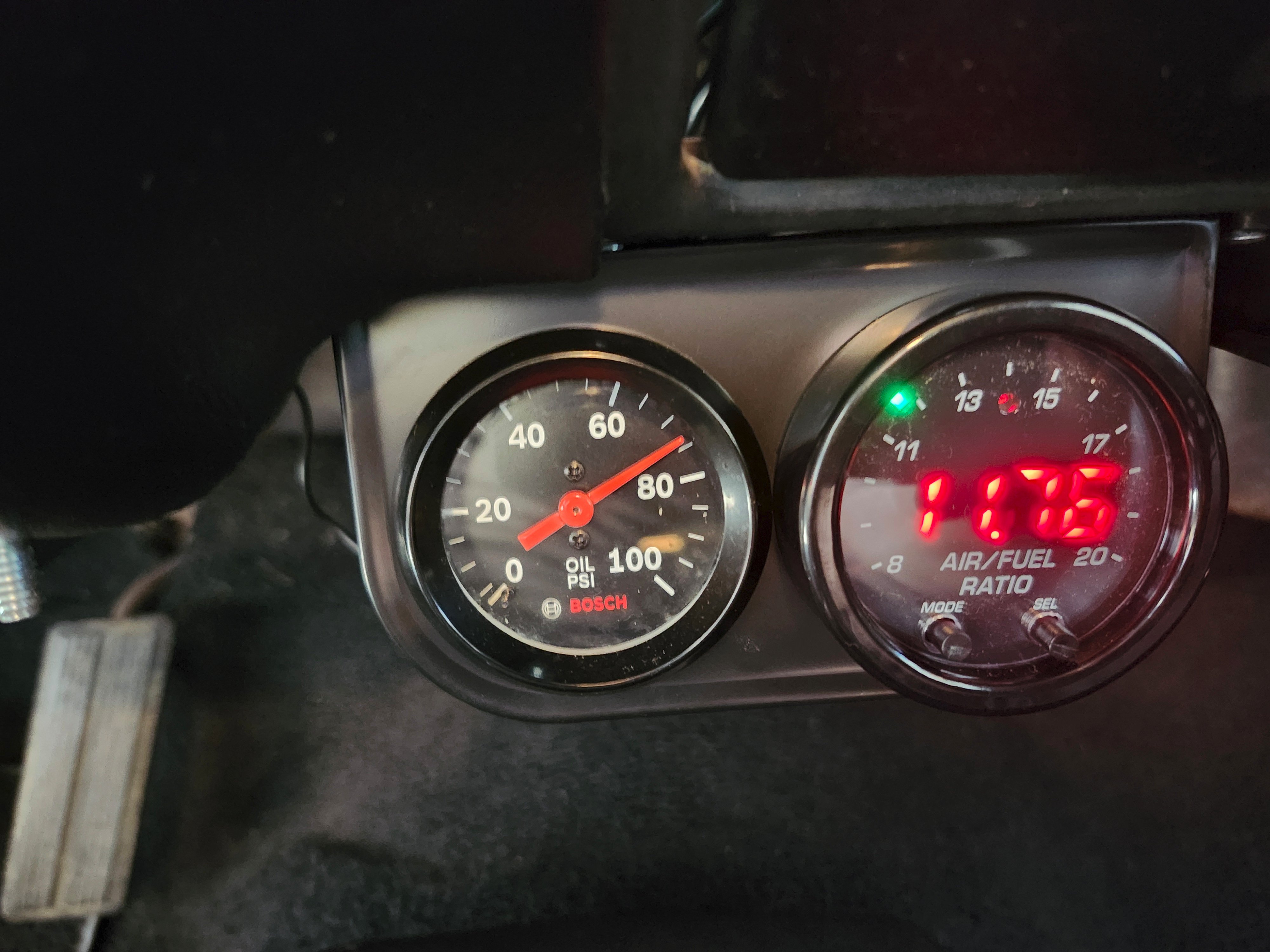
AFR Gauge.jpg
 
I'll offer a few points on the first time use of a wide band O2;

First, with most any cam in a performance engine, you will not be able to dial the idle mixture in with it. With any valve overlap, the reversions will make the readings basically worthless. I can provide details, but that is the long and short of it.

Second, things happen very fast when going through the RPM range. As such, trying to watch the O2 AND drive is near impossible. So, the ability to record is almost mandatory. As is RPM tracking with the ratio.

And the only way to fix your best WOT ratio is at the track. With consistent atmosphere, simply jet up until it slows down and back up to the best jetting. Then you can use the O2 to dial in the curve.

When trying to set the steady speed/cruise ratio, even a narrow band can get you there, so a basic wide band with no other features can too.

.
 
Cruising the AFR is 11 to 12.5 with the gauge showing green. I will consult my Edelbrock tuning kit and try to get this to 12-13. I made a few WOT up to 80 mph and gauge stayed between 12 - 15 on both runs. Cuda has decent power and runs well for a stock step, so wasn't expecting to find some hidden power but its nice tge gauge confirmed rich at idle and cruise, much like I expected as you can smell it during cruising and bit of eye watering even with garage doors open
 
That 'reading' is exactly why I recommended the record function. But again, the WOT is best set at the track anyway. The fuel curve can then be adjusted using the O2. But it doesn't sound like the OP wants to dig that deep.

I believe that the only real advantage of the O2 in this case is to help dial in the cruise and possibly to diagnose problems as to whether they may be fuel related vs some other cause.

And the cruise is more difficult to adjust on the CarterBrocks. They have significant limitations compared to the Holley platforms. Not the least of which is the fact that the metering rods only have 2 steps. Original AFB and AVSs had 3 steps. But when you look at the CarterBrock tuning charts, you can see why the newer ones only have the 2 steps.
 
Don't forget to check the plugs too. The AFR gauge setup is great for seeing how changes to your carb & timing affect things but the plugs will tell the real story.
 
Agreed on plug checks , will be doing that soon. Also had this motor for 6 years and never checked timing and with AFR gauge install i decided to check vacuum, air idle settings and timing. Timing was 20 BTDC damn. So moved back to 10 BTDC , adjusted idle, air idle screws, and vacuum to max (20). Haven't gone for drive yet but that bad timing set may have also been contributing to unburned fuel at idle.
 
Agreed on plug checks , will be doing that soon. Also had this motor for 6 years and never checked timing and with AFR gauge install i decided to check vacuum, air idle settings and timing. Timing was 20 BTDC damn. So moved back to 10 BTDC , adjusted idle, air idle screws, and vacuum to max (20). Haven't gone for drive yet but that bad timing set may have also been contributing to unburned fuel at idle.
Actually, we need to give the engine what it wants with timing. Twenty is a little high, but going back to 10 is likely too much retard. Retarded timing will cause the engine to run hot, be down on power, and generally be unhappy. If you have an auto trans, the RPM drop going into gear should be minimal when it's timed right. A rule of thumb is to advance the timing while the engine is idling until it quits running faster, then retard it a little. Reset your idle speed then drive it. If it pings when going thru transition (from idle to midrange) back it down a little more. Think you'll find the engine likes 16-18 initial.
 
Back
Top