
• Welcome to For E Bodies Only !

    We are a community of Plymouth Cuda and Dodge Challenger owners. Join now! Its Free!

Engine compartment wiring brake light warning switch

unclejesse

Active Member
Joined
Jul 15, 2026
Messages
35
Reaction score
16
Location
Nebraska
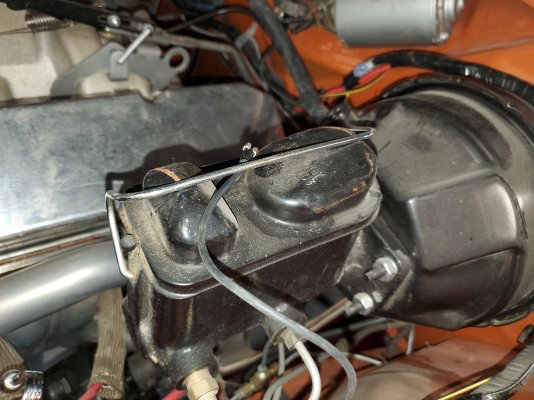
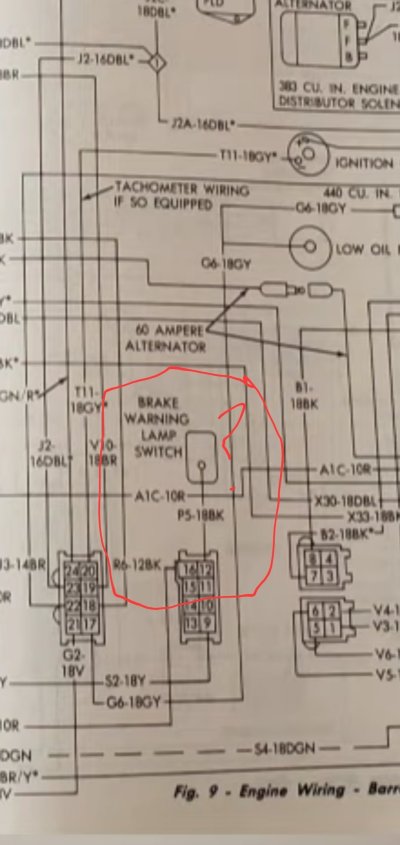
Please explain this on the wiring diagram. On my 70 barracuda in the engine compartment this wire goes to nothing. Just a connector end not connected to anything. On inside of car it goes to the e-brake switch & light. It seems to turn on the brake light. But I don't understand where it's meant to be going in the engine compartment side. The switch seems like it's on the e-brake pedal on the inside. Screenshot_20260822_152536.jpg
 
this thing deal, on the fender well, below the master cylinder. the wire connects to the safety switch of this assembly, in between the two lines going up to the master cylinder.
1787433703403.jpeg
 
The switch on the proportioning showed by pschlosser. It turns the brake light on when there is a problem with the brake system.
When the system is working correctly. There is residual pressure in the system that keeps the light off. It completes the ground for the brake light. Same for the parking parking switch. Just for those that might not know.
 
Last edited:
I have an aftermarket disc brake system in there. Maybe I don't have this connection anymore?

the brake light in the rear & the e-brake light works on the dash. I don't see anywhere to connect the end on what I have at the brake area.
17874410290198971270524035133629.jpg
 
See my reply above. I don't think I have this device any longer with the disc brake aftermarket system?
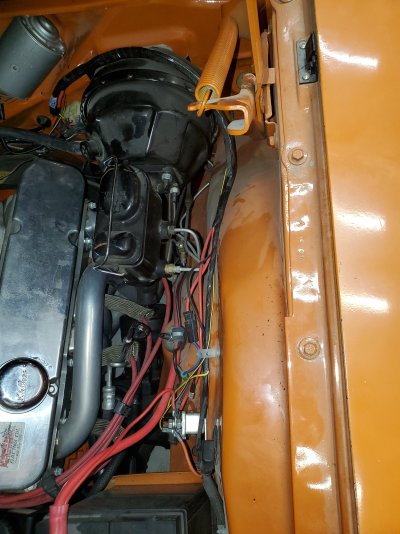
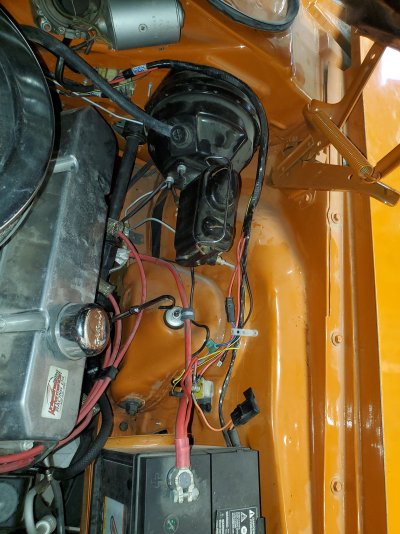
you should have it. zoom out, and give us a bigger picture of the fender well area on the driver side, around, in front of, and below the master cylinder. behind the battery tray. that whole side.
 
The OP is not kidding. The Hydraulic Safety Switch does indeed appear missing. I thought it all breaks down without that part. I am poorly equipped to comment and help on setups that deviate this far from OEM.
 
The OP is not kidding. The Hydraulic Safety Switch does indeed appear missing. I thought it all breaks down without that part. I am poorly equipped to comment and help on setups that deviate this far from OEM.
I have a Milwood disc brake system. I had it professionally installed. Apparently that piece got tossed out with the new system.
I put the wire to a ground & indeed it did turn on the light. But it still works with the e-brake light. I guess I'll just block it off.
 
The light was not put there by accident. It was put there because of accidents. It gives a warning there is something wrong. I would have to venture to guess. If the system didn't incorporate the safety switch.
It reads for off road use only. This is an instance where the fine print would relieve the manufacture of all liabilities
Myself I would look into incorporating it.
 
Last edited:
The light was not put there by accident. It was put there because of accidents. It gives a warning there is someting wrong. I would have to venture to guess. If the system didn't incorporate the safety switch.
It reads for off road use only. This is an instance where the fine print would relive the manufacture of all liabilities
Myself I would look into incorporating it.
Well, fair enough. Though there's lots of safety features I don't have on this 1970 car.
There isn't that distribution body on mine. The brake lines leave the MC & go to one spot that looks just like basic plumbing or a brass T that goes out. Maybe there's a spot somewhere on there.
 
There isn't that distribution body on mine. The brake lines leave the MC & go to one spot that looks just like basic plumbing or a brass T that goes out.
I'm not proclaiming what to do. I would follow the a design of the manufacture. If it would be Wilwood, Chrysler or other. The brake safety switch should be on a street car. If there is one can be adapted to your system. It has to tie the circuits together so the imbalance can be detected. I think the simplest way it get a stock one for car. It takes all the physics into considerations. An aftermarket more than likely would need more set up to be correct. If it going on a race course that's completely different . You know what your doing at that point.
 
Back
Top