
• Welcome to For E Bodies Only !

    We are a community of Plymouth Cuda and Dodge Challenger owners. Join now! Its Free!

Need the car now

Kevineng

Active Member
Joined
May 6, 2024
Messages
39
Reaction score
42
Location
Minnesota
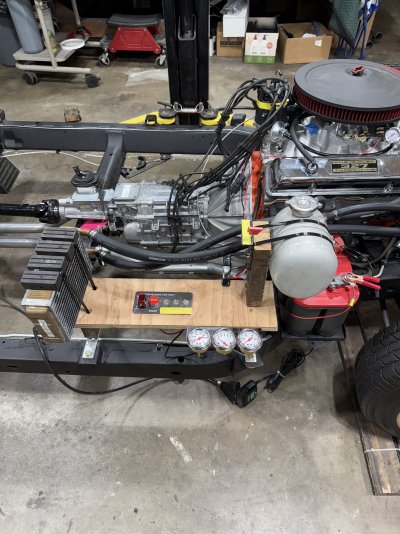
Got it all back together, and tested. Glad I spent the time to set this up. Sounds sweet (cant upload a video). Most importantly, I wanted to test for leaks or other issues. The machine shop forgot to tighten the oil port bolts on the back of the block.....if I had went through all that work to install in the car, then rip the tranny off to find and fix that leak.......I would have been really pissed off, way easier to remove tranny when not in the car.
I'm not perfect either, had a couple of water pump leaks, but that's easy to fix with extra silicon on the bolts.
Question for the steering pump/box guys......with this set up, whether the engine is running or not, the effort it takes to turn the input to the box feels the same, I can only assume, that the pump only works/assists when there is a load on the output shaft (i.e. turning the wheels when its all put back together and weight of car is on tires). I can hear the pump "work" a little when I hit the end stops on the box.
Now to finish the car.........long ways to go on that.

20251120_083604.jpg
 
Yeah, without it in the car and the wheels on the ground, you won't notice the difference with or without the pump working. But when it's altogether and on the ground, you'll know whether or not it's working. Chrysler power steering takes a lot of muscle when the pump isn't working! 🙂
 
Wow. What a setup. This is a great post especially for the guys who are going to be doing this job in the future.
In my corner of the world there are very few remaining machine shops that rebuild motors. The ones that still do have a hard time finding qualified machinists. So the formula is to get the most experienced guy you can, pay him well, then hire several people to do the heavy lifting/take instructions from him. Makes sense financially but then problems arise technically which is also what I came across.
I ran into a situation like this with a corvette I restored a couple years ago. I used the frame as my run stand. When I got the motor back I installed it, the drivetrain behind it and dialed in the bell housing for the TKX 5 speed. A lot of work. Prior to startup I decided, on a whim, to do a quick compression check. Well, a few seconds after I spun the engine and got my first read, I noticed a half cup of fresh oil pooling up directly under the area below the flywheel.
It was too much oil to be a rear main seal so the transmission, clutch, flywheel etc all have to come back out. Chevys have 3 hex head cam plugs in the rear of the SBC. They were all in place. However, one of those plugs was not like the others. See pics.

IMG_5520.jpeg

IMG_5523.jpeg

IMG_0316.jpeg
IMG_5518.jpeg

IMG_5446.jpeg

I guess in hindsight I feel pretty good I trusted my gut and went ahead with the compression check. If I would have fore gone this, assembled the body on the car and went for a startup, that would have forced 60lbs of pressurized oil into the new clutch/bell housing. And of course, having to pull the motor/transmission out of a freshly painted C2 corvette is never fun.
That was not the only problem. The intake manifold bolts were not torqued, at all. Oil was getting past the #8 exhaust valve guide. I punted and went with a Blueprint motor after that.

BTW. The hex head plug with the hole in it actually has a purpose. It was meant to be used to add extra oil to the timing chain in certain BBC.
I’m having the 340 in my 73 Cuda rebuilt by a machinist in a neighboring city. I told him this story and before I could finish it he blurted out the real purpose before I could. A good machinist is worth his weight in gold.
 
Back
Top