
• Welcome to For E Bodies Only !

    We are a community of Plymouth Cuda and Dodge Challenger owners. Join now! Its Free!

Too Tight Steering

cv70chall

Well-Known Member
Joined
Feb 4, 2013
Messages
123
Reaction score
10
Location
South Florida
I finally was able to get all my steering components replaced that needed to be. Had an alignment done and the care seems to drive "very tight".
I was told that sometimes, newly installed components take time to "loosen up or break in", which results in steering returning to normal.
I've noticed that the steering seems "very tight" and that I feel some creaks- and even can hear the lower collar closest to the dash sometimes struggling to turn either way. Is this mainly due to "new parts not broken in", the column and steering assembly being too tight, or the column needing to be fully lubricated?
I did not experience any of these symptoms until after replacing the worn components.

Thoughts?
 
If by tight, you mean responsive and sensitive to input, and lacking in the slop one may feel from a vintage (20+ years old and 100,000 miles or more) automobile with power steering, then I agree, this may loosen in time... but a long time, like 30K-50K miles of driving, unless you take it off-roading on a weekend joyride. This tightness is those fresh new bushings, ball joints, and tie-rod ends keeping the alignment dead-nuts accurate, even under a load in the turns or hard acceleration.

Add to this, the potential of polyurethane bushings making the responsiveness even better, such that one can practically feel when the tire rolls over a pebble ion the roadway.

But if by tight, you mean the pivoting of the steering seems tight, and/or the steering doesn't return to straight when driving in a flat grade loosely holding the steering wheel, I disagree. The ball joints and tie-rod ends are typically greased, and should pivot and rotate freely without much operational friction.

With the front wheels up on jack stands, and the engine idling, one can "steer" the car by moving the wheels themselves, left and right.

I would not think a newly rebuilt front suspension would need road-time to loosen up enough, where any perceptible friction in the steering mechanism is freed.

A front-end alignment by a tire and wheel place is not likely to find or discover friction in the steering system, since the alignment process is mostly stationary on a rig, lift, or platform. However, Positive Caster is the alignment setting that resists turning left and right at higher speeds, and after turning, pulls the wheels back straight, again.

What you describe MIGHT BE binding on the steering linkage, due to a number of factors, potentially incorrect parts, or some other issue.

But we leave it to you to clarify further, what you feel and think as you drive the car.
 
thinking of this further, if the positive caster was set higher than its supposed to be, this may cause your tight behavior. but I would expect the wheels-off-the-ground-and-turning-by-hand test would still require little effort.
 
I rebuilt my front end also and have no steering tightness. When I brought it in for the alignment, I was told that I have play in the steering due to the steering box being worn. The alignment is good but could be better if not for that.
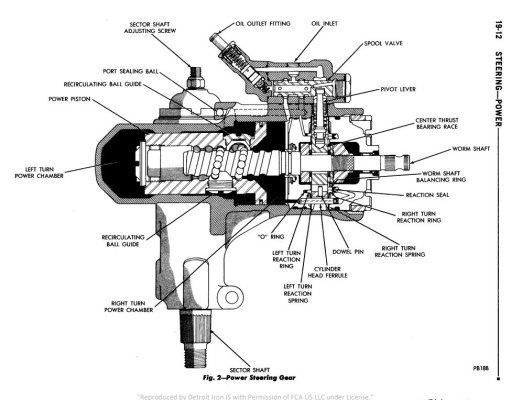
In order to get the play out of the steering box, I tried to adjust the sector shaft up/down to get the play out for the steering box. The further I went up or down the tighter my steering became. So I have no adjustment left in my steering box. (reference chapter 19 in the FSM)
Maybe your alignment shop tried to adjust play in your steering box and made the steering tight.

Steering box.jpg
 
Maybe your alignment shop tried to adjust play in your steering box and made the steering tight.

Adjusting the power steering box seems beyond the scope of a front-end alignment. If the shop did indeed adjust it, I would consult with a lawyer.

But I guess this would imply the alignment service provider was aware of the tightness.

If this tightness wasn't there, prior to alignment, just take it back and whine about it.
 
Last edited:
I finally was able to get all my steering components replaced that needed to be.
I have replaced a component or 2 without an alignment. No problems. If I tear it apart and I have the intent of an aliment.
I replace everything. A component can be hanging up. Get the front up and check it. With out the car running. As you disconnect or connect each side check the feel. Disconnect each side from the center link. Then see how the steering wheel and center link feel.Leave the idler arm on with the Pittman arm. Every component should move with some effort. this will sort out if it's steering. The suspension would be next.
 
Last edited:

Fathoming Heavy Steering: An Overview​

A steering wheel that requires excessive effort to turn can be frustrating and, more importantly, dangerous. When your steering feels tight, it impacts your ability to maneuver the car safely, especially in emergency situations. It’s essential to identify the cause of this issue and address it promptly. Several factors can contribute to stiff steering causes, and the severity of the problem can vary. Is your car steering heavy? Let’s explore why.

The Key Components of Your Steering System​

Before diving into the specific causes, it’s helpful to have a basic understanding of the steering system’s main components:

  • Steering Wheel: The input device that initiates the turning process.
  • Steering Column: Connects the steering wheel to the steering gear.
  • Steering Gearbox or Rack and Pinion: Translates the rotational motion of the steering wheel into linear motion to turn the wheels.
  • Power Steering Pump: Provides hydraulic assistance to reduce the effort required to turn the steering wheel (in vehicles equipped with power steering).
  • Power Steering Fluid: The hydraulic fluid that transmits pressure from the pump to the steering gear.
  • Hoses and Lines: Carry the power steering fluid between the pump, reservoir, and steering gear.
  • Tie Rods: Connect the steering gear to the wheel hubs, allowing the wheels to turn.
  • Ball Joints: Allow for suspension movement while maintaining steering control.

Common Stiff Steering Causes​

Several potential culprits can cause a steering wheel difficult to maneuver. Here’s a look at some of the most frequent offenders:

1. Low Power Steering Fluid​

  • Explanation: The most common and often the simplest reason for a hard to turn steering wheel is low power steering fluid. The fluid is what creates the hydraulic pressure. This pressure assists in the steering process.
  • Symptoms: Steering wheel resistance turning, especially at low speeds, whining noise when turning the steering wheel, jerky steering.
  • Diagnosis: Check the power steering fluid reservoir. Look for the “Min” and “Max” or “Cold” and “Hot” level indicators.
  • Solution: Top up the power steering fluid to the appropriate level. If the fluid is consistently low, look for leaks in the system.

2. Power Steering Pump Failure​

  • Explanation: The power steering pump is responsible for circulating power steering fluid and generating the hydraulic pressure needed for easy steering. A failing pump won’t provide sufficient assistance.
  • Symptoms: Steering feels tight at all speeds, loud whining or groaning noise from the pump, jerky steering, complete loss of power steering.
  • Diagnosis: Check the pump for leaks, listen for unusual noises, and check the drive belt for proper tension and condition. A mechanic can use a pressure gauge to test the pump’s output.
  • Solution: Replace the power steering pump.

3. Power Steering Hose Issues​

  • Explanation: Damaged or blocked power steering hoses can restrict the flow of fluid, leading to stiff steering.
  • Symptoms: Steering feels tight, leaks around the hoses or fittings, hissing sound from the hoses.
  • Diagnosis: Visually inspect the hoses for cracks, leaks, or kinks.
  • Solution: Replace damaged or leaking power steering hoses.

4. Steering Rack Problems​

  • Explanation: The steering rack is the mechanical component that translates the steering wheel’s rotation into the movement of the wheels. Internal damage or wear in the rack can cause it to bind and require more effort to turn.
  • Symptoms: Steering wheel not turning smoothly, play in the steering wheel, clunking noises when turning, uneven tire wear.
  • Diagnosis: A mechanic can inspect the steering rack for play, leaks, and damage.
  • Solution: Replace or rebuild the steering rack.

5. Steering Column Issues​

  • Explanation: Although less common, problems within the steering column itself can also contribute to steering tightness. This could involve worn bearings, damaged universal joints, or a binding tilt mechanism.
  • Symptoms: A grinding or binding sensation when turning the steering wheel, difficulty adjusting the steering wheel position, unusual noises coming from the steering column.
  • Diagnosis: Requires a thorough inspection of the steering column components by a qualified mechanic.
  • Solution: Repair or replace the affected components within the steering column.

6. Belt Problems​

  • Explanation: The power steering pump is driven by a belt connected to the engine. If the belt is loose, worn, or cracked, it may slip and not properly drive the pump.
  • Symptoms: Squealing noise, especially when turning the steering wheel, stiff steering, particularly at low speeds.
  • Diagnosis: Inspect the belt for wear, cracks, or looseness.
  • Solution: Replace or tighten the belt.

7. Suspension Component Issues​

  • Explanation: Problems with suspension components such as ball joints, tie rod ends, or struts can create additional resistance in the steering system, making the steering feel heavy.
  • Symptoms: Noises when turning or going over bumps, uneven tire wear, loose steering.
  • Diagnosis: Visually inspect the suspension components for wear and tear. A mechanic can perform a more thorough inspection and test for play.
  • Solution: Replace worn or damaged suspension components.

8. Tire Pressure​

  • Explanation: Underinflated tires increase rolling resistance. This makes the steering wheel feel harder to turn.
  • Symptoms: Steering feels heavier, especially at low speeds.
  • Diagnosis: Check tire pressure with a gauge.
  • Solution: Inflate tires to the recommended pressure.

9. Wheel Alignment​

  • Explanation: Improper wheel alignment can cause the tires to fight against each other, making the steering feel tight.
  • Symptoms: Vehicle pulls to one side, uneven tire wear, steering wheel is not centered.
  • Diagnosis: Have the wheel alignment checked by a professional.
  • Solution: Align the wheels to the manufacturer’s specifications.

10. Frozen or Seized Components​

  • Explanation: In colder climates, moisture can get into steering and suspension components and freeze, causing them to bind. Rust and corrosion can also cause components to seize over time.
  • Symptoms: Steering feels very stiff, especially when starting the car after it has been sitting for a while.
  • Diagnosis: Visual inspection for rust or corrosion.
  • Solution: Lubricate or replace seized components.

Diagnosing Steering Problems: A Step-by-Step Approach​

If you’re experiencing steering issues, here’s a suggested approach to diagnosing the problem:

  1. Check the Power Steering Fluid: Start by checking the power steering fluid level and condition.
  2. Inspect the Belt: Examine the power steering pump drive belt for wear, cracks, and proper tension.
  3. Listen for Noises: Pay attention to any unusual noises coming from the power steering pump or steering system when turning the steering wheel.
  4. Visual Inspection: Carefully inspect all power steering components, including hoses, lines, and the pump, for leaks or damage.
  5. Check Tire Pressure: Ensure that all tires are inflated to the proper pressure.
  6. Test Drive: If the problem persists, take the vehicle for a test drive to further assess the steering behavior and identify any additional symptoms.
 
Back
Top